System Integration
Reading between the datasheets — with functional safety built in, not bolted on.
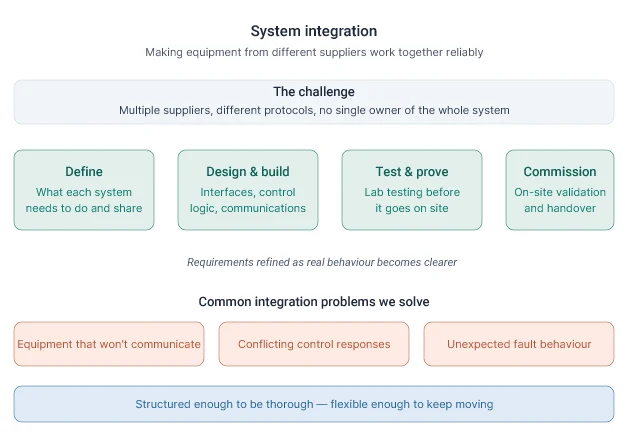
Most complex systems aren't built by one company. A vessel might have generators from one manufacturer, a battery system from another, power converters from a third — and a control system that has to tie the lot together. The same applies in industrial and energy installations: equipment from different suppliers, speaking different protocols, designed without knowledge of each other.
We take on the integration work from requirements through to validation — anticipating how equipment will actually behave on a shared network rather than trusting the datasheets, prototyping early to flush out problems before commissioning, and building functional safety in from first principles rather than bolting it on at the end. Structured and traceable, without drowning the project in documentation.
The Problem
Each supplier's kit works on its own bench
Put it all on the same network and problems appear — communication timing, conflicting control responses, unexpected behaviour during faults, or simply systems that don't share the information needed to operate as a whole. That gap between "equipment delivered" and "system working" is where projects tend to struggle.
What We Do
Read between the datasheets
Know how equipment actually behaves, not just how it's specified. Anticipate the integration problems before they show up during commissioning — where they cost days of standby time per fix.
Structured — without document drag
Requirements through validation, traceable and thorough. But we prototype early, test continuously and refine as real system behaviour emerges. When requirements change because something didn't behave as expected — and they usually do — the process absorbs it.
Functional safety, built in
Safety requirements considered from first principles — not bolted on once the architecture is frozen. That avoids the common trap where integration and safety work against each other, or duplicate effort across two separate workstreams.
Tested as a whole, not piece by piece
Integration problems hide in the gaps between equipment — communication timing, fault handling, conflicting control responses. We exercise the full integrated system in our dedicated test facility through software-in-the-loop (SiL) and hardware-in-the-loop (HiL) before commissioning, so most of those problems get found and fixed off-site rather than on the vessel or plant. See Test and Validation for the staged approach.
Get in touch
Talk to us about marine electrification
Our Address
Bracken House, 51 BRACKEN ROAD, SANDYFORD BUSINESS PARK, DUBLIN, Dublin 18, Ireland, D18 CV48