Marine Electrification & Hybrid Systems
The engineering that sits between the equipment and a working vessel.
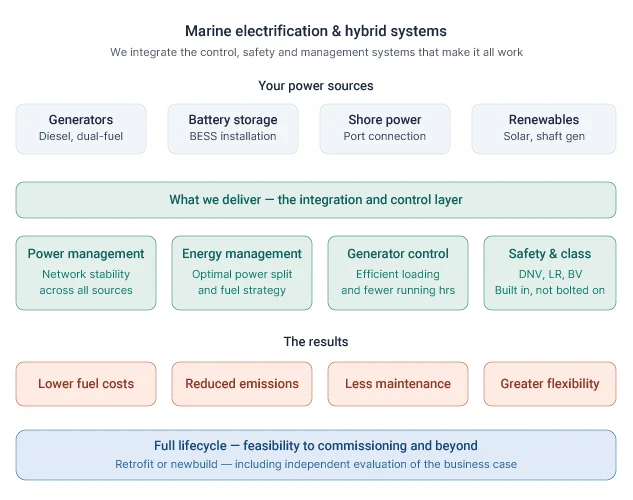
Hybridising a vessel is a coordination problem. The power management system (PMS), the energy management system (EMS) and every energy source — generators, batteries, shore power, renewables — all have to behave predictably on the same bus, in every operating mode, and across every fault scenario. That is harder than it sounds, and most projects find out the hard way.
We have years of experience delivering marine hybrid systems that work as intended — retrofits or newbuilds, from feasibility through to in-service support.
The Problem
Every piece is correct in isolation — the trouble starts when they meet
Each vendor's equipment works fine on its own bench. The PMS keeps the network stable, the EMS dispatches energy, the BMS protects the cells, the genset has its AVR. Put them on the same bus, across every mode and every fault, and the interactions rarely match the datasheets. On hybrid vessels, fault current contributions change depending on what's online — so even "obvious" protection schemes need to be re-validated for every combination, not just the convenient ones.
The symptoms when the integration is under-engineered
These show up during commissioning, sea trials or — worst of all — in service:
- Unstable voltage or frequency during mode changes and transfers.
- Black-outs or breaker operations triggered by routine load steps.
- Nuisance trips and protection that doesn't coordinate during faults.
- Generators running outside their efficient band, shortening overhaul intervals.
- EMS decisions that are correct on paper but conflict with what the PMS does on the bus.
- Late classification-society comments and re-work that should have been designed out at the start.
None of these are unusual. All of them are the result of treating integration as something you do at commissioning, rather than something you engineer from the outset.
What We Do
Power management
Keeping the vessel's electrical network stable when generators, batteries, shore power and variable loads are all on the same bus — in every combination, including the awkward ones.
Energy management
Deciding when to charge, discharge, start or stop a generator, and how to split load across available sources. Peak shaving, spinning-reserve replacement, zero-emission port operation — strategies tested in simulation against your actual operational profile before they go on board.
Generator optimisation
Keep gensets in their efficient operating band. A properly integrated battery system reduces running hours, extends overhaul intervals, and in some cases removes the need for a generator altogether.
Class-approved safety architecture
DNV, Lloyd's Register and Bureau Veritas battery rules. Ventilation logic, gas detection response, fire suppression sequencing and failure analysis — designed in from the start, not documented afterwards to satisfy a surveyor.
Full-lifecycle support
From feasibility to in-service support
Operational profile analysis, feasibility, detailed design, factory acceptance, commissioning, sea trials — and ongoing support once the vessel is operational. We also help owners evaluate whether hybridisation makes financial sense based on real operational data, not supplier projections.
Get in touch
Talk to us about marine electrification
Our Address
Bracken House, 51 BRACKEN ROAD, SANDYFORD BUSINESS PARK, DUBLIN, Dublin 18, Ireland, D18 CV48