Tirfinn
Array Management Unit — a battery supervisory controller for multi-string installations.
TIR-FIN · Irish Gaelic: tír (land) + finn (derived from energy)
Built on Bachmann industrial control hardware, the AMU combines a proven, safety-capable platform with our application-specific software for battery supervisory control.
Wiring multiple battery strings into a single installation creates problems that a string-level BMS was never designed to solve. Each string has its own protection, its own fault thresholds and its own idea of when to disconnect — and none of them know what the others are doing. None of them are responsible for how the installation as a whole behaves when something goes wrong.
That gap widens as soon as fire-and-gas, ventilation, the wider electrical plant and a classification-society surveyor are involved. Without a supervisor sitting above the strings, independent BMSs produce uncoordinated outcomes — which is the opposite of what a safety-critical installation needs.
Why it's needed
String-level BMSs don't make system-level decisions
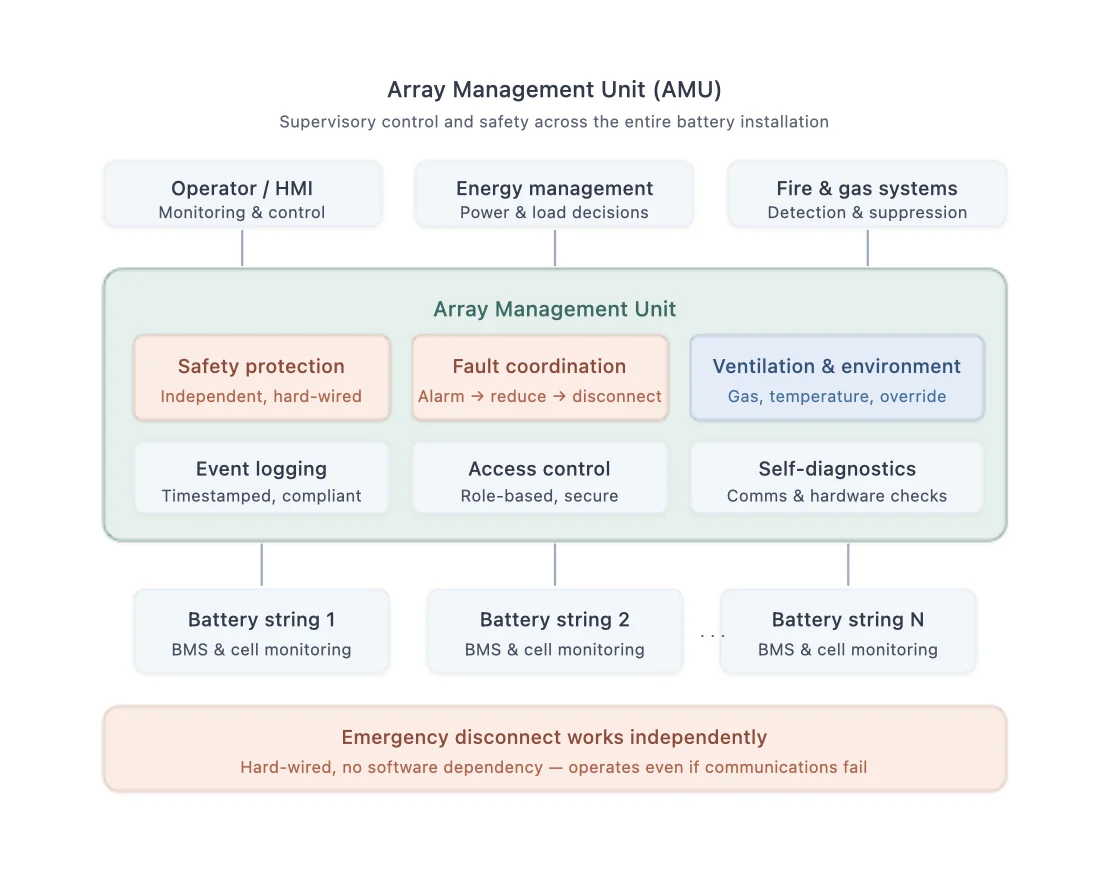
Each battery string has its own BMS handling cell-level monitoring and balancing. But the decisions that affect the whole installation — when to disconnect a faulted string, how to sequence a controlled shutdown, what to do when gas is detected or fire suppression activates — need to be made at system level, consistently and predictably.
Without a dedicated supervisory controller, those responses depend on individual BMS units acting independently. That creates gaps and coordination failures when it matters most.
What the AMU does
Independent safety protection
- Overcharge detection, automatic disconnection on gas detection, and a hard-wired emergency disconnect that works regardless of software or communications status. If a protective trip occurs, restarting requires deliberate operator action — not an automatic reset.
Coordinated fault handling
Alarms first, then load reduction, then disconnection if needed. Deterministic sequencing, predictable behaviour — giving the wider system time to respond before a shutdown. Continuous monitoring for communication and hardware failures, with managed safe restarts after power loss.
Environmental monitoring & ventilation control
Automatic activation on gas detection or high temperature, with manual override capability. In marine installations, where batteries sit in enclosed spaces, this is a critical safety function.
Direct interfacing with fire & gas systems
The AMU coordinates between gas detection, fire suppression and electrical isolation — making sure the right things happen in the right order, not in whatever sequence each subsystem decides independently.
Event logging & role-based access
Every event recorded with timestamps for compliance and incident investigation. Access is role-based and secured across all interfaces — cybersecurity considered from the outset, not retrofitted.
Where it's used
Multi-string installations, marine and stationary
Designed for multi-string battery installations in marine vessels and stationary energy storage sites. Meets the safety and fault-handling requirements expected by classification societies and regulatory bodies, with cybersecurity considered across all interfaces from the outset.
At a glance
Specification
- Platform: Bachmann industrial control hardware
- Safety protection: hard-wired emergency disconnect, overcharge detection, gas-triggered disconnection
- Interfaces: CAN, Modbus, Ethernet (application-configurable)
- Environmental interfaces: gas, temperature, ventilation, fire suppression
- Target applications: multi-string marine battery systems, stationary BESS
- Detailed datasheet and dimensions — available on request
Get in touch
Request a datasheet or a conversation
Our Address
Bracken House, 51 BRACKEN ROAD, SANDYFORD BUSINESS PARK, DUBLIN, Dublin 18, Ireland, D18 CV48